網誌內容

此處內容大致為本人所整理的論文及心得。 為推廣視光相關知識,文章歡迎轉載,但請註明出處。
歡迎對視光有興趣者一起研究討論或給予指教,謝謝大家。因為不常看留言,所以有問題請直接寄信。

星期二, 10月 31, 2023

外斜視兒童的近視研究

 Comparing myopic error in patients with basic and convergence insufficiency intermittent exotropia in China - PubMed (nih.gov)


比較外斜視兒童的慣用眼與非慣用眼的近視程度,非慣用眼的近視程度較高。


199位間歇性外斜視兒童,根據遠與近的斜視程度分為兩組,基本型(遠近斜視程度接近)與內聚不足型(近斜視明顯大於遠)。再進一步分類為屈光參差與非屈光參差。

結果

-內聚不足型之慣用眼等值球面度- 2.09 ± 1.45D,非慣用眼 - 2.53 ± 1.44D。

-基本型慣用眼等值球面度 - 2.46 ± 1.56D,非慣用眼 - 2.89 ± 1.37D 

-兩組相同,慣用眼的近視程度顯著小於非慣用眼


其中屈光參差(雙眼屈光度差異大於等於1.00D)有43位,非屈光參差有156位。

-屈光參差組的近外斜量45.26 ± 24.41 PD,遠外斜量33.53 ± 23.31 PD

-非屈光參差組的近外斜量 43.42 ± 20.69 PD,遠外斜量 29.07 ± 16.84 PD

-兩組之間無顯著差異


散瞳劑與角膜塑型術(OK鏡片)的使用與兒童雙眼視覺相關研究

 Accommodation and vergence function in children using atropine combined with orthokeratology - PubMed (nih.gov)

62位8-12歲兒童分為四組,第一組結合使用0.01% atropine與OK鏡片,第二組使用安慰劑與OK鏡片,第三組使用0.01% atropine與鏡框眼鏡,第四組控制組使用安慰劑與鏡框眼鏡。

研究開始與三個月後,評估雙眼視覺功能,包括horizontal phoria, fusional vergence, the accommodative convergence/accommodation (AC/A) ratio, accommodative lag, and accommodative amplitude (AA)。

結果

1.調節遲緩僅OK鏡片組有顯著改進,其他三組未改變

Accommodative lag significantly decreased in the OK group (P = 0.002), but remained unchanged in the other three groups (all P > 0.05).

2.雙眼調節靈巧度與正相對調節在結合組與OK鏡片組有進步,其他兩組未改變

Binocular accommodative facilities and positive relative accommodations increased in the combination and OK groups (both P < 0.05) , but remained unchanged in the atropine and control groups (both P > 0.05). 

3.僅OK鏡片組的內斜位有顯著降低。

Only the participants with esophoria in the OK group had a significant decrease in esophoria (P = 0.008).

4.融像性聚散與AC/A在四組間無顯著差異

Changes in fusional vergence and AC/A did not significantly differ between the four groups (all P > 0.05).


星期二, 7月 04, 2023

HUMPHRISS IMMEDIATE CONTRAST (HIC,一種雙眼同時打開的驗光方式)

     在單眼驗光之後需要進行雙眼調節平衡,方式有很多種,其中一種較特別的方式為HUMPHRISS IMMEDIATE CONTRAST (HIC)。概念是先霧視非檢查眼,接著在檢查眼之前輪流以+/-0.25DS鏡片比較清晰度。

    此種方式的好處是兩眼皆處於開放狀態,有雙眼融像更接近真實視覺狀態,調節也能有較好控制。

    當比較兩片鏡片時。會有三種可能的結果,+0.25DS比較清楚、-0.25DS比較清楚、兩者相同    

    但不同教科書上對於步驟及終點卻有不同的描述,又因為最原始的版本無法獲得,所以我試著比較手上三本有比較完整步驟的教科書,看看不同作者的作法。


1. Clinical Procedures for Ocular Examination 4th

/NANCY B. CARLSON,  DANIEL KURTZ

這本是大部分視光學校的屈光實驗教科書,書上對於終點是這麼描述的

  • a. If the patient reports that the -0.25 D sphere is clearer, add-0.25 D to the correction (or take away + 0.25 D) and continue step 5 until the two views appear equal.
  • b. If the +0.25 is preferred, add a +0.25 to the correction and continue step 5.
    • If on the next comparison the patient prefers the -0.25, add the -0.25 and proceed to step 6.
  • c. If the two views appear equal, leave the correction as is and proceed to step 6

...終點為直到兩片鏡片看起來相同.而正或負清楚則加入相對應鏡片之後到反向出現.


2. OPTOMETRY : Science, Techniques and Clinical Management

/Mark Rosenfield, Nicola Logan

  • lf the patient is not accommodating, then they should immediately respond that the target is clearer with the minus lens.
  • lf the patient gives one of three responses , either that
    • (1) the plus lens is clearer
    • (2) that there is no difference between the two lenses or
    • (3) that the minus lens is clearer, but it makes the letters smaller or blacker,
  • then it can be assumed that the patient is accommodating.
  • With any of these three answers, additional plus sphere should be added and the test repeated until the patient has no hesitation in responding that the-0.25 DS is preferred.
...終點為負鏡片清楚.兩者相同或正鏡片清楚或負鏡片影像縮小則繼續加正鏡片

3. Clinical Procedures in Primary Eye Care

/David B. Elliott

  • 6. If the patient immediately reports that the-0.25 DS is definitely clearer, repeat the demonstration of the lenses and ask if the-0.25 DS ‘is definitely clearer or just smaller and blacker’.
    • Only add -0.25 DS if the patient immediately reports that the lens is definitely clearer.
  • 8 .If the patient reports that the +0.25 DS is clearer or that there is no difference, add +0.25 DS to the refractive correction
  • 10.Continue to compare the -0.25 DS and +0.25 DS until the +0.25 DS is immediately rejected.
...終點為正鏡片被立即拒絕.正鏡片清楚或兩者相同繼續加正鏡片


星期六, 7月 10, 2021

雙眼不等視與不等像

 兩眼度數有差距稱為屈光參差Anisometropia,兩眼看到影像不一樣大叫做不等像Aniseikonia。

眼睛屈光是由眼球屈光能力與眼軸長所決定,軸性屈光參差用眼鏡矯正時,雙眼影像大小差異比較小,屈光性屈光參差用隱形眼鏡矯正時,雙眼影像大小差異較小。

1.軸性屈光參差表示雙眼屈光能力接近,但眼軸長不一致。以薄透鏡眼鏡所造成的雙眼影像大小差距的百分比約為"0.1 x X x (兩眼鏡片度數差)",X為鏡片離眼睛前焦點距離。

例如若鏡片較前焦點接近眼睛2mm,則兩眼每差距1.00D,影像大小約相差0.2%


2.屈光性屈光參差表示雙眼眼軸長接近,但屈光力不同,以薄透鏡眼鏡所造成的雙眼影像大小差距的百分比約為"0.1 x d x (兩眼屈光度差),d為鏡片距角膜頂點距離。

例如若鏡片距角膜12mm,則雙眼屈光度每差距1.00D,影像大小約相差1.2%


參考資料為Clinical Visual Optics 3rd / RONALD  B  RABBETTS


星期五, 7月 02, 2021

驗光或測視力時的距離要多遠?


圖片來源The Eyes Have It at Your Essential Eye Exam | Premier Health

先說結論,"越遠越好"。教科書上的距離都是20英尺或6公尺,國內驗光人員法規定是最短5公尺,若用鏡子反射則最短2.5公尺。

太短會發生什麼問題呢? 這會牽涉到光聚散度、眼睛調節與屈光不正的原理,主要會有兩個問題產生。

一、所測視力有誤差

首先當物體離眼睛越近時,物體發出的光越呈現發散狀態,越遠越不會發散,無限遠則接近平行光。

再來說到屈光不正,例如近視眼是一種眼球屈光力過強的現象(因此須戴凹透鏡矯正),當物體位於眼前近距離時,物體發散的光正好與近視眼球過強屈光力抵銷,因此近視眼的人在未戴眼鏡時,不須調節即能看清近距離物體。

所以輕微近視的人在較短驗光室內能輕鬆得到良好的視力。

但這是不正確的視力結果

例如近視-0.50D眼睛在2公尺驗光距離,不戴眼鏡即有最佳視力;而若在5或6公尺以上距離的標準驗光室,光線不再發散,此時視力即會變差。

二、驗光距離太短還會造成另一個問題就是驗光的度數會有誤差

當物體較近時,光線會發散,此時眼睛為了看清楚會動用調節力提高眼睛屈光力。

這在驗光時就會造成問題。

驗光過程我們並不希望眼睛處於用力調節的狀態,所以在度數裡面就會加入一部分的正度數去取代眼睛所提高的屈光力,結果就是會驗出較低的近視度數或較高的遠視度數。

例如在標準距離的驗光室驗出-1.00D的近視眼,在2公尺的驗光距離若同樣戴-1.00D將使眼球必須用力0.50D,此時若換成-0.50D的眼鏡,眼睛反而不需用力,所以會被誤判為近視-0.50D。

當然驗光過程牽涉到非常複雜的設定與程序,檢查距離只是其中一個環節。

合法的驗光所都有標準的驗光距離及有執照的驗光人員,或者大家檢查眼睛時也可以自行判斷或詢問驗光室的距離(成年男子一步約60公分),太近的話須用鏡子反射,否則將有一定的誤差會產生。


參考資料

PRIMARY  CARE OPTOMETRY, 5th Theodore Grosvenor, O.D., Ph.D.,  F.A.A.O.

"Because rays of light diverging from a point 6m from the eye have a vergence of 0.17D on reaching the eye, "optometric infinity" differs from real infinity by an appreciable amount. When testing distances shorter than 6 m are used,what  effect should we expect this to have on visual acuity?

As long as letter size is such that a 6/6 (20/20) letter subtends an angle of 5 minutes  of  arc at the spectacle plane,an emmetrope or an uncorrected hyperope with reasonable facility of accommodation would be  expected to have no difficulty clearing up the letters at a distance less than 6 m.However, an uncorrected myope would be expected to have artificially high visual acuity under these circumstances. 

For example, at a testing distance of 3 m (10 feet), a 0.33 D myope would be in perfect focus and would  likely read at least one more line of  letters  than at the 6 m distance. In the experience of the author, visual acuity for uncorrected (and corrected) myopes becomes a problem for testing distances much closer than about 5 m (16 feet).

The effect of testing distance on visual acuity should not be confused with the effect of testing distance on refractive findings.  For an acuity chart at 4 m, the  vergence  of light is 0.25 & for all patients, no matter what the refractive  state, so myopes  will  tend  to  be  underminused  and hyperopes will tend to be  overplussed.  If the testing  distance must be less than 20 feet, the use of  a mirror system should be considered."


星期六, 3月 20, 2021

AC/A ratio調節性內聚與調節比值的一些教學心得


  • 雙眼內聚的目的是為了雙眼融像,但在沒有融像的情況下也會有內聚發生,例如調節時會連帶引起內聚產生,此時稱為調節性內聚AC
  • 調節性內聚AC的程度因人而異,有人高有人低,會影響眼位偏斜的大小與方向,是一個重要的參數,過高或過低都可能會造成雙眼視覺的異常症狀,也會影響後續處置方式。
  • 既然知道AC會影響眼位,那要知道AC的程度只要觀察眼位的變化就可以了,但...只有這樣是不夠的。
  • AC就像不同車子加滿油跑的距離有多有少,但並不代表那台車油耗程度,因為油箱可能不一樣大,應比較的是在相同油耗之下所跑的里程數。
  • 所以AC要再除A,才能得到在相同調節之下的AC比較,所以要比較的是調節性內聚與調節比值AC/A,每一個屈光度的調節改變所引起的調節性內聚變化,就像每一公升所跑的里程數。
  • 因為AC/A是調節所引起的內聚變化,而調節的改變方式可以用距離的改變或球面鏡片度數的變化來達成,前者就稱為計算性AC/A比值,後者就稱為梯度性AC/A比值
  • 計算性AC/A比值觀察遠與近的眼位與調節變化,梯度性AC/A比值觀察固定距離下球面度數改變前後的眼位變化
  • 雙眼視覺正常原則是調節會引起調節性內聚,所以當距離移近或加入負度數時,會使調節增加,造成AC增加,所以眼位內轉增加,使外斜位減少或內斜位增加;反之當距離移遠或加入正度數,會使調節減少,調節性內聚減少,所以眼位內轉減少,使外斜位增加或內斜位減少。

星期日, 3月 07, 2021

視光學新書發行(包含內容更正)

更新 : 2022版已上市!


    自從驗光人員法考試施行以來,已經不記得上過多少場次的視光學與驗光學複習班課程,個人的習慣是每次上課的內容都會有一些更新與增刪,也一直有出版社洽談出書的事宜。但直到最近這一兩年才慢慢有一點時間將手上的資料整理成書。我想對於沒有時間上實體課或上過課還想複習的考生是個不錯的選擇,內容較為淺顯易懂也適用對視光學想快速上手的讀者或學生。

    本書由新文京出版社發行,可至公司網站或電洽購買管道。

https://www.wun-ching.com.tw/book_detail.asp?seq=13010

    另外因爲初版且眼睛老花日益嚴重,難免有疏漏錯誤之處,所以我將書中發現的錯誤陸續整理於此(會不斷更新),有問題的讀者歡迎與我聯繫,感謝大家。

最後更新時間:9月27日 2021年

2021版勘誤

  • P75   例題2 : 第二行“測眼 90 度方向於處可以看到中和點” 應改為“測眼 90 度方向於50公分處可以看到中和點“
  • P124 最後一行 : 應改為“水平焦線在前,垂直焦線在後”。
  • P141 第23題解析 : "-2.75 至平光共加入+2.75D 為 NRA",應為 "-2.00 至平光共加入+2.00D 為 NRA"
  • P151 倒數第三行 : (log0=1)應為(log1=0)
  • P160 第2題: 正確答案應為(A
  • P163 第1題 : 正確答案應為(B
  • P185 第8題 : 正確答案為 (C
  • P243 第2題 : 正確答案應為B
  • P267 第十行 : 6.33應為6.67、第十一行1.67應為1.33、第十四行0.55D應為0.44D、第十五行-0.55D應為-0.44D
  • P278 第17題 : 正確答案應為B
  • P286 圖5-1 : 內偏斜-往左看時內偏斜增加-“右眼外直肌” 應為 “眼外直肌”

星期三, 3月 27, 2019

雙眼視覺機能異常的人群分布情況


Images of our population(圖片來源https://isso.columbia.edu/content/statistics)


若眼睛的健康情況良好,沒有斜視與弱視,且經過適當的屈光矯正之後,仍然出現模糊、眼睛疲勞甚至雙重影像,就有可能是眼睛的視覺功能出現異常。

可分類為三種
調節異常-眼睛調焦功能出現異常
聚散異常-雙眼視軸對齊功能出現異常
眼動異常-物體動態移動時追視功能出現異常

在網路上搜尋最近的幾篇論文,可以了解這些異常在人群當中大致的分布情形。
因為調查採計的標準與對象有許多不同,結果差異也很大,
但大致上約佔人口當中的二到三成。

1.
2002的研究,265位有症狀的患者,其中59位 (22.3%)具有視覺功能異常

細分的話

調節功能異常 9.4%

-accommodative excess (6.4%)

-accommodative insufficiency (3%)

聚散功能異常 12.9%

-Convergence excess (4.5%)

-convergence insufficiency (0.8%)


2.
2001的研究,1679位18~38位民眾,高達 56.2% 呈現雙眼視覺功能異常症狀

調節失常61.4%

聚散失常38.6%

症狀者當中最常見的是Accommodation insufficiency 11.4%


3.
1997的研究,65位有大量視覺工作需求的大學生,32.3% 顯示一般的雙眼視機能失常

10.8% accommodative excess

7.7% convergence insufficiency with accommodative excess.

6.2% accommodative insufficiency.

3.1% had basic exophoria

1.5% Convergence excess with accommodative insufficiency,

1.5%basic esophoria

1.5%fusional vergence dysfunction


4.
作者系統性回顧1986至2009的文獻,分布情況有很大的差距,特別是調節不足(2-61.7%)及內聚不足(2.25-33%),因為對象及採用的標準不同而異。


四篇文獻如下

1.

https://onlinelibrary.wiley.com/doi/abs/10.1046/j.1475-1313.2001.00540.x
General binocular disorders: prevalence in a clinic population


Francisco Lara Pilar Cacho Ángel García Ramón Megías
First published: 23 August 2002 https://doi.org/10.1046/j.1475-1313.2001.00540.x Cited by: 54
ePDFPDFTOOLS SHARE


Summary
The purpose of this paper was to study the prevalence of nonstrabismic accommodative and binocular dysfunctions in a clinical population. We examined 265 symptomatic patients who were chosen from an optometric clinic. We performed several tests to diagnose any form of refractive, accommodative or binocular dysfunction. Of the 265 subjects examined, 59 patients (22.3%) had some form of accommodative or binocular dysfunction and required not just the correction of the refractive error but a specific treatment for each of the problems diagnosed. The remaining subjects were classed as having refractive anomalies. The frequency of binocular dysfunctions was 12.9%, and 9.4% for accommodative anomalies. Convergence excess (4.5%) was more prevalent than convergence insufficiency (0.8%) and accommodative excess (6.4%) more prevalent than accommodative insufficiency (3%).


2.

https://link.springer.com/article/10.1007/s12009-001-0027-8

Annals of Ophthalmology

September 2001, Volume 33, Issue 3, pp 205–208 | Cite as

Prevalence of general dysfunctions in binocular vision

Authors

Authors and affiliations

Robert Montés-Micó

Abstract

A 1-year clinical trial to determine the prevalence of general dysfunctions in binocular vision in a nonpresbyopic population was conducted in 1679 subjects aged 18 to 38 years. A thorough eye examination included binocular vision testing. A high prevalence of binocular vision dysfunctions was found. Of the subjects, 56.2% presented symptoms of binocular dysfunctions, 61.4% with accommodation disorders and 38.6% vergence disorders. Accommodation insufficiency was most prevalent among those with symptoms (11.4%).

3.

https://europepmc.org/abstract/med/9097328

Prevalence of general binocular dysfunctions in a population of university students.

(PMID:9097328)

Porcar E , Martinez-Palomera A

Optometry and Vision Science : Official Publication of the American Academy of Optometry [01 Feb 1997, 74(2):111-113]

Type: Journal Article

Abstract

PURPOSE: Although some authors report that the prevalence of general binocular dysfunctions (nonstrabismic) for nonpresbyopes in the clinical population is greater than any condition except refractive error, limited research is available to support this statement. This clinical study determined the presence and clinical implications of these conditions in a population of university students with heavy near visual demands. METHODS: From a group of second year students who were given a thorough eye examination, 65 students were selected. The criteria for selection were the absence of significant uncorrected refractive error, healthy eyes, and no strabismus or amblyopia. RESULTS: 32.3% of the subjects showed general binocular dysfunctions. In 10.8% of the cases, accommodative excess was present. 7.7% had convergence insufficiency with accommodative excess. 6.2% showed accommodative insufficiency. 3.1% had basic exophoria. Convergence excess with accommodative insufficiency, basic esophoria, and fusional vergence dysfunction all showed the same prevalence of 1.5%. CONCLUSIONS: Accommodative and nonstrabismic binocular vision problems are prevalent in this population. Accommodative excess is the most common condition. Because these dysfunctions may have a negative effect on performance, appropriate vision evaluation for this population is important.


4.

https://www.sciencedirect.com/science/article/pii/S1888429610700285

Review Do we really know the prevalence of accomodative and nonstrabismic binocular dysfunctions?

Author links open overlay panelPilarCacho-MartínezaÁngelGarcía-MuñozaMaría TeresaRuiz-Canterob

Show more

https://doi.org/10.1016/S1888-4296(10)70028-5

Abstract

Purpose
To determine the scientific evidence about the prevalence of accommodative and nonstrabismic binocular anomalies.

Methods
We carried out a systematic review of studies published between 1986 and 2009, analysing the MEDLINE, CINAHL, FRANCIS and PsycINFO databases. We considered admitting those papers related to prevalence in paediatric and adult populations. We identified 660 articles and 10 papers met the inclusion criteria.

Results
There is a wide range of prevalence, particularly for accommodative insufficiency (2–61,7 %) and convergence insufficiency (2.25–33 %). More studies are available for children (7) compared with adults (3). Most of studies examine clinical population (5 studies) with 3 assessed at schools and 1 at University with samples that vary from 65 to 2048 patients. There is great variability regarding the number of diagnostic signs ranging from 1 to 5 clinical signs. We found a relation between the number of clinical signs used and prevalence values for convergence insufficiency although this relationship cannot be confirmed for other conditions.

Conclusion

There is a lack of proper epidemiological studies about the prevalence of accommodative and nonstrabismic binocular anomalies. Studies reviewed examine consecutive or selected patients in clinical settings and schools but in any case they are randomized and representative of their populations with no data for general population. The wide discrepancies in prevalence figures are due to both sample population and the lack of uniformity in diagnostic criteria so that it makes difficult to compile results. Biases and limitations of reports determine that prevalence rates offered are only estimations from selected populations.


星期一, 7月 09, 2018

聚合近點(Near point of Convergence, NPC)的預期值比較


聚合近點(Near point of Convergence, NPC)或是內聚近點,是眼視光初步檢查中的一個重要步驟,為評估雙眼內聚能力(類似鬥雞眼動作)的重要指標之一,如果測試結果異常,則很可能在看書或近距離活動時容易眼疲勞或出現雙重影像。

操作方式一般是將視標由遠而近逐漸靠近眼睛,1.當觀看者表示出現雙重影像或2.觀察者發現雙眼之一往旁邊移開失去對焦,以上1或2兩者之一出現時,測量此時視標到觀看者鼻子(鏡框平面)之距離,稱為破裂點,如在一定範圍(預期值)之內,則此項測試為正常。

但預期值因研究者測試對象而有所不同,在不同視光教科書上有不同數值,這邊列出幾本視光常用書籍及較近的研究做個比較。

結論是許多舊版的書,破裂點數值在7cm左右,而新版的書,數值則都減少到2.5cm左右,而較近的研究則在5cm。

1.Clinical Procedures for Ocular Examination, Fourth Edition

視標為筆燈
破裂點Break 2.4-2.9 cm/回復點Recovery 4.2-5.0 cm

(同一本書,前一版的數值,破裂點Break:  5 cm 
/回復點Recovery:  7 cm )

2.PRIMARY  CARE OPTOMETRY, 5™ EDITION

視標為筆燈,破裂點預期值為8cm

原文如下
The expected value of the near point  of  convergence is approximately 8 cm or less, as measured from the spectacle plane. If the near point of convergence is found to be in the neighborhood of 12 to 15 cm on repeated testing, the examiner  should  suspect  the  convergence  insufficiency  syndrome.

3.CLINICAL MANAGEMENT OF Binocular Vision
Heterophoric, Accommodative, and Eye Movement Disorders

第四版
調節性視標Accommodative target Break: 2.5 cm ±2.5
Recovery:4.5 cm ±3.0
筆燈Penlight and red/green glasses Break: 2.5 cm ±4.0
Recovery:4.5 cm ±5.0

第三版
筆燈Penlight/red-green glasses  break:  7 cm  ±4.0 
recovery:  10 cm  ±5.0 

4.BORISH'S CLINICAL REFRACfION, SECOND EDITION

平均值3cm

原文如下
The mean NPC is 3 cm (±4 cm) from the spectacle plane (midforehead), and the recovery finding is 2 or 3 cm larger. NPC findings greater than 7 cm and recovery findings greater than 10 cm are generally regarded as inadequate and could be signs of a convergence insufficiency.


然後到Pubmed上用關鍵字搜尋,查到2017的統計
對象是20多歲的年輕人,平均值是 NPC: 5.27±3.60 cm


Strabismus. 2017 Mar;25(1):5-11. doi: 10.1080/09273972.2016.1276937. Epub 2017 Jan 17.
Binocular and Accommodative Characteristics in a Normal Population.


Yekta A1, Khabazkhoob M2,3, Hashemi H4, Ostadimoghaddam H5, Ghasemi-Moghaddam S1, Heravian J5, Doostdar A6, Nabovati P3.

Author information


Abstract

PURPOSE:


To study binocular and accommodative characteristics and their associations with age and gender in an Iranian young adult population.
METHODS:


In this cross-sectional study, multistage cluster sampling was done from the students of Mashhad University of Medical Sciences. All participants had visual acuity, refraction, and cover tests followed by measurements of the near point of convergence (NPC), amplitude of accommodation (AA), monocular and binocular accommodative facility (MAF and BAF) using ±2.00 diopter (D) flipper lenses, and negative and positive relative accommodation (NRA and PRA). Near and distance fusional vergence reserves were measured using prism bar, and near associated phoria was assessed using the Mallett unit.
RESULTS:


The mean age of the participants was 22.5±4.4 years (range: 18-35 years). The binocular and accommodative characteristics and their means in the studied sample included: mean distance dissociated phoria: 1.15 exophoria±2.04 prism diopters (PD), near dissociated phoria: 5.02 exophoria±4.74 PD, near associated phoria: 0.55 base-in±1.02, gradient accommodative convergence/accommodation (AC/A) ratio: 4.66±1.59, NPC: 5.27±3.60 cm, MAF: 11.33±5.58 cpm, BAF: 8.84±4.47 cpm, NRA: 2.08±0.33 D, PRA:-2.92±0.76 D, and AA: 11.14±2.6 D. In the multiple regression model including age and gender, near exophoria was significantly higher in men and levels of near base-out-break and near base-out-recovery were higher in females. Distance exophoria, distance base-in-break, distance base-in-recovery, and NPC increased with age and near base-out-break, PRA, BAF, MAF, and AA significantly decreased with age.
CONCLUSION:


Studied indices in this study significantly differ from available guidelines and these differences must be considered when making diagnostic or therapeutic decisions. Certain indices can be affected by age and gender.


2018對學童的統計,平均值在

near point of convergence break, 5-10cm

J Optom. 2018 Jun 7. pii: S1888-4296(18)30032-3. doi: 10.1016/j.optom.2018.03.005. [Epub ahead of print]
Normative values for clinical measures used to classify accommodative and vergence anomalies in a sample of high school children in South Africa.


Wajuihian SO1.

Author information
1

Discipline of Optometry, School of Health Sciences, University of KwaZulu-Natal, Private Bag X54001, Durban 4000, South Africa. Electronic address: swajuihian@mweb.co.za.

Abstract

AIM:


To determine normative values for stereoacuity, accommodative and vergence measures for high school populations.
METHODS:


Using a multi-stage random cluster sampling, 1211 children (481 males and 730 females) between 13 and 18 years of age, with a median age of 16 years, were selected. Visual acuity, stereoacuity and suppression, refractive errors, near point of convergence, heterophoria and fusional vergences, as well as, amplitude of accommodation, accommodative response, facility and relative accommodation were evaluated.
RESULTS:


Most data did not have a normal distribution. The range of normality for the vergence measures were: near point of convergence break, 5-10cm, recovery, 6-13cm, near lateral phoria, 2.5-6 prism dioptre (pd) (nasal), near vertical, orthophoria to 0.50pd, negative fusional vergence break, 12-23pd, recovery, 8-17pd, positive fusional vergence break, 16-35 and recovery 11-24pd. For accommodative measures, the range of normality for accommodative measures was: amplitude of accommodation, 12-18pd, accommodative response, plano to +0.75D, binocular accommodative facility, 5-12 cycles per minute (cpm), negative relative accommodation, 1.75-2.50DS, positive relative accommodation, -2.0 to -3.0DS and 17-69s arc for stereoacuity.
CONCLUSION:


This study provides norms for clinical measures which could be used to classify accommodative and vergence parameters for children aged 13-18 years in this population or beyond. Findings should be applied in the context of the measurement techniques and the associated limitations outlined in this report.


星期三, 10月 11, 2017

淺談視力與視力的表示方式

一、視力的定義

眼睛的功能就是看東西,而評估看東西的能力(即視覺)其中一個最重要的指標就是視力,同時視力也相關於很多社會及法律問題,如保險或社會福利的認定標準等。

視力有許多不同的定義,但基本觀念是眼睛的辨識能力,也就是能辨認越小的物體,代表視力越好。

不過相同大小的物體,若與眼睛的距離不同,視覺感受上會有不同的大小。例如眼前的飛機很巨大,天上的飛機看起來就很小,許多的借位攝影也都是利用此原理。


http://www.classes.com.hk/news/lifestyle/%E6%8B%8D%E7%85%A7%E6%96%B0%E7%8E%A9%E6%B3%95%EF%BC%9A%E5%80%9F%E4%BD%8D%E6%94%9D%E5%BD%B1

所以在衡量眼睛的辨識能力時,不能以實際物體的大小作為標準,還須加上距離的考量。在視光專業的領域,我們將這兩個變數以一個變數來表示,即是以物體相對於眼睛的視角作為標準,視角越小代表視力越好;若視角相同,則視力相同。


二、視力的表示方式

前面說過視力以視角來表示,而個人所能辨認的最小視角稱為最小分辨角MAR(Maximum angle resolution最大辨認能力),代表個人最佳的視力。
因為人眼的辨識能力很高,所以這是一個很小的角度,通常以1度角的60分之一的分角為計算單位,正常視力的人眼分辨能力約為1分角。

又因為視角越小代表視力越好,所以臨床上為了方便,我們將視力以視角的倒數來表示。
同時這也是台灣常用的視力表示方式,我們稱為小數視力

例如
分辨0.5分角(MAR=0.5)的視力為1/0.5=2.0
分辨   1分角(MAR=1)  的視力為    1/1=1.0
分辨   2分角(MAR=2)  的視力為    1/2=0.5
分辨   5分角(MAR=5)  的視力為    1/5=0.2
數字越大視力越好

但在歐美常用的是分數視力
由兩個數字組成  分子/分母
分別代表兩個距離,分子代表測試距離,分母代表辨識能力1分角時的距離(可以想成表示視標的大小)
簡單的說將分子/分母的結果就等於小數視力

例如
若以英制英呎為單位,檢查距離為20英呎(約等於6公尺)
20/10=視力2.0
20/20=視力1.0
20/40=視力0.5
20/100=視力0.2
前面分子的數字固定的情形下,後面分母的數字越小視力越好


還有一種視力表示方式是將視角取對數,稱為對數視力
通常用於研究用途
例如
分辨1分角(MAR=1)的視力為Log1=0
分辨2分角(MAR=2)的視力為Log2=0.3
分辨5分角(MAR=5)的視力為Log5=0.7
數字越小視力越好,高於1.0視力時會出現負值

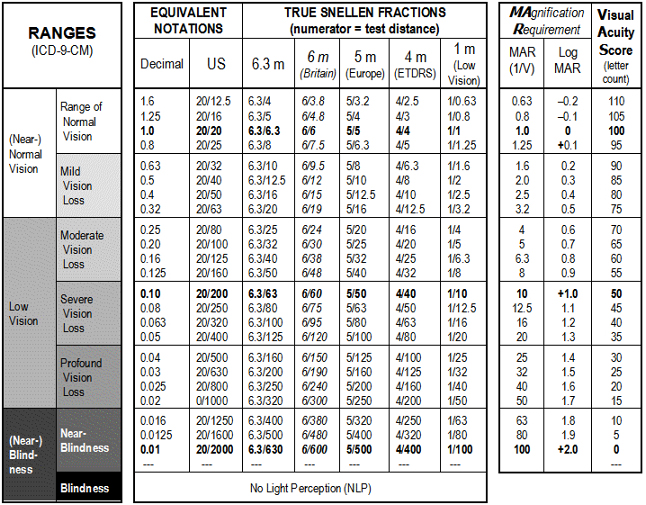
以下為各種視力之間的對照表
Decimal為小數視力
Snellen為分數視力的表示,英美制與不同距離的公制
MAR與LogMAR分別為最小分辨角與對數視力
VAS為視力指數(一種較新的標準視力表示方式)


http://www.precision-vision.com/a-visual-acuity/


星期二, 1月 03, 2017

散光成像及鐘面圖30法則原理

散光為屈光不正的一種,與近視及遠視的不同在於其網膜上的像不成為一個焦點,而是兩條焦線。

在規則性散光當中,眼屈光系統的兩條主徑線分別在網膜附近成為兩條互相垂直的焦線。

依兩條主徑線的屈光強度而決定其前後
  • 屈光力較強主徑線成像在前
  • 屈光力較弱主徑線成像在後
以矯正鏡片的負柱鏡矯正屈光力較強的主徑線
定義屈光力較弱的主徑線為散光的軸度

多數人眼睛的垂直方向的屈光力較強,因此稱為順規散光
如上圖右
  • 90度屈光力強,形成180度焦線在網膜之前
  • 180度屈光力弱,形成90度焦線在視網膜之上,為散光軸
因此多數人在近視且順散,未矯正情形之下,會覺得垂直方向的線條較清楚。
也就是患者覺得清楚的方向與其處方軸度方向相差90度
所以可以利用此原理,請患者陳述覺得最清楚的方向,判斷其散光軸度。

最簡單而普遍的方式就是鐘面圖,在霧視的情況下,讓患者觀看時鐘狀的圖形,描述其所見最清楚的線條,最清楚的鐘點數x30即為其散光軸度。


如上圖,患者覺得6-12最清楚,在時鐘上及視網膜上皆為90度方向,因此其散光軸度為與90垂直的180度。6x30=180

如上圖,患者覺得3-9最清楚,在時鐘上及視網膜上皆為180度方向,因此其散光軸度為與180垂直的90度。3x30=90

但到這邊卻無法解釋其餘角度,例如1-7清楚為散光軸度1x30,但在患者所見時鐘上卻是60度清楚(以三點鐘為座標0度),而與60度垂直的是150度,並不是30度。

這是因為患者所見方向與檢查者所見試鏡架上的方向是左右相反的。

如上圖,3-9清楚時,雖然同樣為180度,但患者所見0度在時鐘的3點鐘(耳側)方向,而在試鏡架上耳側方向卻是180度。


如上圖,患者所見1點鐘為時鐘的60度方向,而實際上在患者的試鏡架上卻是120度。

如上圖,因此患者覺得清楚的方向在眼內為120度,模糊的是30度,因此其散光軸度為30度。

依此類推2-8方向清楚為散光軸度60度,最模糊焦線為60度,最清楚焦線為150度。


星期五, 8月 21, 2015

光線強度、藍光與近視


http://wechat.fingerdaily.com/thread-107470-1-1.html
以上是google查到的圖-犯了那些錯誤呢?


沒時間的就直接看結論與建議! 有部分可能跟您所想的不同!

結論

  1. 實驗顯示,在低光照時,眼睛會對於影像劣化較為敏感,長時間低亮度近距離工作,會導致近視容易增加。
  2. 從統計數據來看,學童每天於戶外明亮環境活動能有效對抗近視發展。
  3. 在成長階段,短波長的光(接近藍光的波長)似乎對眼球的生長有一定的調節作用,且較能抑制近視的發生。

建議

  1. 每天要有一段時間於戶外明亮光線下活動。
  2. 近距閱讀工作,要有明亮且舒適的白光照明。
  3. 不要為了趕潮流長時間(包括室內)配戴太陽眼鏡。
  4. 不建議成長中的學童配戴抗藍光鏡片,無益於近視控制。
  5. 關於藍光的傷害-不管何種波長,只要能量過強,都會傷害視網膜。


有興趣的就看看以下相關的研究結論及參考文獻~

一、關於光亮度與近視的研究文獻


  1. 學校兒童夏季的近視增加較慢。
  2. 雞近視實驗--高亮度環境飼養雞未近視,低亮度環境卻製造近視;高亮度環境飼養雞其中一眼戴太陽眼鏡,帶鏡眼近視。高亮度的環境,不管陽光或人工燈光,皆能阻止雞近視形成
  3. 光亮度阻止近視可能與dopamine(一種神經傳導物質,經研究與近視的形成有關)有相關性,實驗雞注射dopamine拮抗劑能消除光的保護作用。
  4. 猴實驗類似,且發現連續5小時以上高光照才有效。
  5. 也能解釋戶外活動對近視防治的效果。
  6. 對眼的影像品質--亮光-瞳孔縮小能增加焦深,使網膜上影像清晰。暗-瞳孔放大-球面像差增加(近視者像差較正視者大)。
  7. 低亮度對雙眼視覺也有負向作用,若有內斜問題者情況會惡化。


二、關於光波長與近視,目前的實驗及研究

色光--  紅橙黃綠藍紫
波長--   較長--- 較短
  1. 光具有色散現象-過濾藍光鏡片會表現出輕微近視。
  2. 此色散現象是否會影響人眼偵測網膜影像焦點的正確性及正視化的進行仍有爭議。
  3. 近讀時選擇性地消除長波長,明顯降低調節刺激約0.50D,顯示視覺系統近讀時主要使用長波長光,在分子生物研究中也得到類似的結論。
  4. 豬近視實驗--長波長燈光環境下飼養的豬較易近視及有較深玻璃體腔深度(眼軸長)。
  5. 戶外活動較能減少近視增加,可能由於戶外光線波長較室內燈光短。
  6. 帶著藍色鏡片於戶外活動,眼球生長較慢。
  7. 藍光可能有益於人體中央神經系統的dopamine調整。
  8. 鼠近視實驗--相對於正常白光,養於中波長環境的豬,發展出近視;而飼養於短波長環境的豬,發展出遠視。
  9. 鼠近視實驗--即使用負鏡片誘發近視的豬,藍光都能抑制眼軸生長。
  10. 雞近視實驗--紅光誘發近視,藍光誘發遠視。
  11. 猴近視實驗--長波長光是近視的危險因子。

本文主要翻譯於Dr. rer. nat. Klaus Schmid, Physicist所著之
Myopia Manual Edition January 2015,P133-142。個人有所增刪。作者此部分章節所引用的參考文獻如下。

Cui D, Trier K, Munk Ribel-Madsen S. Effect of day length on eye growth, myopia progression, and change of corneal power in myopic children. Ophthalmology. 2013 May;120(5):1074-9    

Woung LC, Lue YF, Shih YF, Accommodation and pupillary response in early-onset myopia among 
schoolchildren, Optom Vis Sci 1998 Aug; 75(8): 611-6    

Charman WN, Radhakrishnan H. Accommodation, pupil diameter and myopia. Ophthalmic Physiol Opt. 2009 Jan;29(1):72-9    

Young, Francis A, The effect of nearwork illumination level on monkey refraction, Am J Optom and Arch Am Acad Optom 1969; 46(9), referenced in referenced in The prevention of acquired myopia, 
http://members.aol.com/myopiaprev/page2.htm    

Lang G, Augenheilkunde, Georg Thieme Verlag Stuttgart New York, 2000, p. 228 

Schaeffel F, Presseerklärung im Rahmen der 96. Tagung der Deutschen Ophthalmologischen Gesellschaft, 19. – 22. September 1998, Berlin    

 Feldkaemper M, Schaeffel F. Are retinal image brightness and spatial frequency distribution independently processed during deprivation myopia development? Investigative Ophthalmology and Visual Science 37: 1497(1996)    

 Ashby R, Ohlendorf A, Schaeffel F. The Effect of Ambient Illuminance on the Development of Deprivation Myopia in Chicks. Invest Ophthalmol Vis Sci. 2009 Jun 10.   

 Ashby RS, Schaeffel F. The effect of bright light on lens compensation in chicks. Invest Ophthalmol Vis Sci. 2010 Oct;51(10):5247-53. Epub 2010 May 5.    

 Optom Vis Sci. 2011 Vol. 88, No. 3; 13th International Myopia Conference Symposium Summaries, Symposium 5, Paper 2 by Ashby R and Morgan I    

 Moore, S. E., Irving, E. L., Sivak, J. G., Callender, M. G.: Decreased light levels affect the emmetropization process in chickens. In: Vision Science and its Applications. OSA Technical Digest Series, Vol. l (Optical Society of America, Washington DC), S. 202-205 (1998)    

 Schmid KL et al. The effect of common reductions in letter size and contrast on accommodation responses in young adult myopes and emmetropes. Optom Vis Sci. 2005 Jul;82(7):602-11    

 Cohen Y et al. Dependency between light intensity and refractive development under light-dark cycles. Exp Eye Res. 2010 Nov 3    

 Smith EL 3rd et al. Protective effects of high ambient lighting on the development of form-deprivation myopia in rhesus monkeys. Invest Ophthalmol Vis Sci. 2011 Dec 14  

Backhouse S, Collins AV, Phillips JR. Influence of periodic vs continuous daily bright light exposure on development of experimental myopia in the chick. Ophthalmic Physiol Opt. 2013 Sep;33(5):563-72   

Lan W, Feldkaemper M, Schaeffel F. Intermittent episodes of bright light suppress myopia in the chicken more than continuous bright light. PLoS One. 2014 Oct 31;9(10):e110906.   

 Roberts JE, Visible light induced changes in the immune response through an eye-brain mechanism 
(photoneuroimmunology), I Photochem Photobiol B 1995 Jul; 29(1): 3-15    

Norton TT1, Siegwart JT Jr. Light levels, refractive development, and myopia--a speculative review. Exp Eye Res. 2013 Sep;114:48-57.  

 Atchison DA, Smith G, Efron N, The effect of pupil size on visual acuity in uncorrected and corrected myopia, Am J Optom Physiol Opt 1979 May; 56(5): 315-23    

 Paquin MP, Hamam H, Simonet P, Objective measurement of optical aberaations in myopic eyes. Optom Vis Sci 2002 May;79(5):285-91    

 Owens, Liebowitz, Accommodation, convergence, and distance perceprtion in low illumination. Am J Optom Physiol Opt 1980 Sep;57(9):540-50   7    REFERENCES 341

 Kersten D, Legge GE, Convergence accommodation. J Opt Soc Am 1983 Mar;73(3):332-8    

 Vannas AE, et al. Myopia and natural lighting extremas: risk factors in Finnish army conscripts. Acta Ophthalmol Scand. 2003 Dec;81(6):588-95    

Lan W1, Feldkaemper M, Schaeffel F. Bright light induces choroidal thickening in chickens. Optom Vis Sci. 2013 Nov;90(11):1199-206.   

 Illuminance – Recommended Light Levels http://www.engineeringtoolbox.com/light-level-rooms-d_708.html    

 Millodot M, Stevenson RW, Electrophysiological evidence of adaptation to colored filters. Am J Optom Physiol Opt 1982 Jun;59(6):507-10    

 Schmid KL, Wildsoet CF. Contrast and spatial-frequency requirements for emmetropization in chicks. Vision res 1997 Aug;37(15):2011-21   

 Kroger RH, Binder S. Use of paper selectively absorbing long wavelengths to reduce the impact of educational near work on human refractive development. Br J Ophthalmol 2000 Aug;84(8):890-3    

 Kubena T, Kubena K, Galatik A, Neumann P. Effect of infrared rays on the eye in progressive myopia. Cesk Slov Oftalmol 1999 May;55(3):155-9    

 Long Q et al. Illumination with monochromatic long-wavelength light promotes myopic shift and ocular elongation in newborn pigmented guinea pigs. Cutan Ocul Toxicol. 2009;28(4):176-80.    

 Optom Vis Sci. 2011 Vol. 88, No. 3; 13th International Myopia Conference Symposium Summaries, Kexnote Lecture 3 by Neitz J and Neitz N.    

 Long Q et al. llumination with monochromatic long-wavelength light promotes myopic shift and ocular elongation in newborn pigmented guinea pigs. Cutan Ocul Toxicol. 2009;28(4):176-80.    

 Hathaway WE. Effects of School Lighting on Physical Development and School Performance The Journal of Educational Research Volume 88, Issue 4, 1995    

 Cowan RL et al. Differential effects of D-amphetamine on red and blue light-induced photic activation: A novel BOLD fMRI assay of human dopamine function. Synapse. 2008 Apr;62(4):268-72. doi: 10.1002/syn.20491.    

 Quian YF et al. Transfer from blue light or green light to white light partially reverses changes in ocular refraction and anatomy of developing guinea pigs. J Vis. 2013 Sep 26;13(11)    

Jiang L et al. Interactions of chromatic and lens-induced defocus during visual control of eye growth in guinea pigs (Cavia porcellus). Vision Res. 2014 Jan;94:24-32   

Foulds WS, Barathi VA, Luu CD. Progressive myopia or hyperopia can be induced in chicks and reversed by 
manipulation of the chromaticity of ambient light. Invest Ophthalmol Vis Sci. 2013 Dec 9;54(13):8004-12   

 Shang YM et al. White Light-Emitting Diodes (LEDs) at Domestic Lighting Levels and Retinal Injury in a Rat Model. Environ Health Perspect. 2014 Mar;122(3):269-76    

 Igor Kanin, Personal communication   a570 

 Liberman J, Light: Medicine of the future, Bear & Co, 1992 


星期五, 10月 24, 2014

關於兒童近視控制所使用之散瞳劑濃度你應該要知道的事

簡單的說

1.長效型散瞳劑(睫狀肌麻痺劑)-阿托品,濃度越高,控制近視的效果越好,但副作用也隨之越強,停藥之後的近視反彈現象也越嚴重,各項視覺功能的恢復期也越長。


2.不同學童對於相同濃度藥物的副作用反應並不完全相同,真正適合的藥物濃度需要經過詳細檢查評估(瞳孔、調節、遠近視力甚至雙眼視覺功能等等...)才能確定。


---------------------------------------------------------------------------------

近視率高居世界之首的台灣,國內推估曾點用散瞳劑之學童約在四成左右。


但許多學童及家長並不完全清楚所點用之藥物種類、濃度、使用方式、注意事項及副作用等。


這是相當危險的事情!!


在Ophthalmology 2012期刊當中,ATOM計畫(Atropine for the Treatment of Childhood Myopia study)回顧過去所做的研究 


發現點用Atropine 1.0%兩年的期間,控制近視的效果可達80%

當濃度下降後,0.5% 可達75%,0.1%可達70%
即使低至0.01%,仍有60%的近視控制效果。

但在停藥一年之後,1.0%點用組的近視快速的增加,幾乎將兩年點用期間所控制的近視,全數奉還。共三年的實驗結果,與點用安慰劑組的結果幾乎相同(點用組-1.37 vs 安慰劑組-1.56)。


而這樣的近視回彈現象,隨著濃度的下降,也漸趨輕微,到0.01%時,已未有明顯的回彈現象。


比較0.5%、0.1%及0.01%點用期間與停藥之後的視覺功能

遠距最佳矯正視力在三組之間無明顯差異
近距視力與瞳孔大小在停用兩個月之後逐漸恢復
調節幅度則需要較長時間恢復,且三組在停藥一年之後仍有顯著差異
以上視覺功能在低濃度組皆有較快的恢復時間

三組當中,0.01%的atropine有較低的近視反彈,因此能有持續的控制效果,且有最低的瞳孔放大與調節損失,停藥後的恢復也較快。似乎對於學童控制近視在藥效與安全性之間有最佳的平衡。


另也有研究者將Atropine的副作用訂出3項目標毒性標準

分別1.為調節小於5D、2.瞳孔放大超過3mm及3.近距離視力無法看清楚J1。

以此標準實驗不同濃度的作用,結果發現當濃度高於0.05%時,皆完全無法通過此標準。

一直要低至0.012%的濃度才勉強通過

但即使是0.012%的濃度,三位受測者當中仍有一位瞳孔放大了3mm,調節幅度僅剩3.60D,且抱怨在戶外時有畏光的現象。


網路上也曾有網友自行稀釋Atropine至0.003125%的經驗分享


參考資料


Chia, A., Chua, W. H., Cheung, Y. B., Wong, W. L., Lingham, A., Fong, A., & Tan, D. (2012). Atropine for the treatment of childhood myopia: safety and efficacy of 0.5%, 0.1%, and 0.01% doses (Atropine for the Treatment of Myopia 2). Ophthalmology, 119(2), 347-354. doi: 10.1016/j.ophtha.2011.07.031

Chia, A., Chua, W. H., Wen, L., Fong, A., Goon, Y. Y., & Tan, D. (2013). Atropine for the Treatment of Childhood Myopia: Changes after Stopping Atropine 0.01%, 0.1% and 0.5%. Am J Ophthalmol. doi: 10.1016/j.ajo.2013.09.020

Chua, W. H., Balakrishnan, V., Chan, Y. H., Tong, L., Ling, Y., Quah, B. L., & Tan, D. (2006). Atropine for the treatment of childhood myopia. Ophthalmology, 113(12), 2285-2291. doi: 10.1016/j.ophtha.2006.05.062

Tong, L., Huang, X. L., Koh, A. L., Zhang, X., Tan, D. T., & Chua, W. H. (2009). Atropine for the treatment of childhood myopia: effect on myopia progression after cessation of atropine. Ophthalmology, 116(3), 572-579. doi: 10.1016/j.ophtha.2008.10.020

COOPER, J. et al. Maximum Atropine Dose Without Clinical Signs or Symptoms. Optom Vis Sci, Sep 26 2013. ISSN 1040-5488.