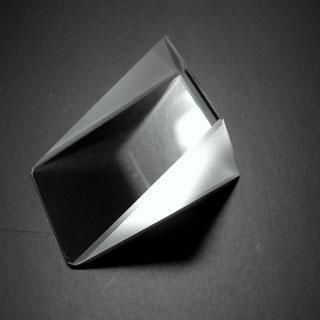
稜鏡是用於處理雙眼視覺異常的工具之一,利用光學上稜鏡可改變光線行進方向,可幫助我們調整雙眼之間眼位的偏差情形。
稜鏡的介紹
http://jim0423.blogspot.com/2011/04/blog-post_28.html
稜鏡的使用遠比我們想的廣泛,而我們並不自知,
思考一下,多數人只有一付遠用眼鏡,在看近時,眼睛位置必定偏離了光學中心,此時即產生了稜鏡效應,而我們大部分並沒有特別感覺。
以下節錄自Clinical Management of Strabismus/Prism Applications p.95
Elizabeth E.Caloroso, O.D., M.Opt., FAAO
Michael W. Rouse, O.D., M.S.Ed., FAAO
稜鏡於臨床上的應用有很多種,緩解稜鏡是最常被處方的一種。
這裡介紹稜鏡的七種類型。
Many types of prism applications are available for clinical
use, with relieving prisms prescribed most frequently.
This chapter includes a review of seven prism types (re-
lieving, corrective, overcorrective, inverse, yoked, rotat-
ing, and regional) and prescribing criteria, with specific
guidelines for prescribing relieving prisms for heterophores
and intermittent strabismics. Other types of prism appli-
cations prescribed for constant strabismics are described
only briefly, with some indicatioins of their clinical uses.
However, the integration of prisms into the total treatment
program for constant strabismus and its associated visual
anomalies is included in the chapters discussing specific
patient types and treatment sequences.
一、緩解稜鏡
降低融像聚散的需求。處方稜鏡度數小於眼位偏差值
Relieving Prisms
Relieving prisms optically reduce the demand to fusional
vergence that controls the deviation and results in bifixation
of a viewed target. The prism power prescribed is less
than the oculomotor deviation (i.e., the phoria in
heterophoria or the dissociated deviation in strabismus)
and has its base in the opposite direction to the eyetum
(i.e., BI for exo, BO for eso, BD for hyperdeviations, and
BU for hypodeviations).
二、矯正稜鏡
完全消除雙眼偏差值,也就是使融像聚散需求降為零。處方稜鏡度數等於眼位偏差值
Corrective Prisms
Corrective prisms optically eliminate the oculomotor
deviation. The prism power prescribed equals the size of
the oculomotor deviation and has the base in the opposite
direction to the deviation. Thus, the residual vergence
demand is zero and the retinal images are centered on the
foveae. Sensory fusion can then occur without the need
for fusional vergence—that is, assuming that the strabismic
eye is not suppressed. When deep suppression exists, the
goal of stimulating normally coiresponding retinal areas
while the eyes remain in the strabismic posture is achieved,
but the additional goal of establishing normal sensory
fusion might not be attained.
三、過矯正稜鏡
改變雙眼偏差的方向,處方稜鏡度數大於眼位偏差值
Overcorrective Prisms
Overcorrective prisms optically change the direction of
the oculomotor deviation. In such cases, the prism power
prescribed is larger than the oculomotor deviation and has
its base in the opposite direction to the eyetum. The most
commonly prescribed power equals the dissociated de-
viation plus 10 pd. Thus, the prism moves the retinal
image beyond the fovea of the viewing eye, and to the
opposite hemiretina than previously stimulated, assuming
that no vergence movements occur. Motor stimulation
becomes opposite to that present without the prisms. For
example, an esodeviation becomes an optical exodeviation,
and the image of the viewed target is now in the temporal
retina rather than the previously stimulated nasal retina
(see Figure 6.8).
四、反轉稜鏡
增加稜鏡聚散的需求。處方稜鏡方向與眼位偏差相反
Inverse Prisms
Inverse prisms optically increase the demand to the con-
trolling fusional vergence. The prism prescribed has its
base in the same direction as the eyetum (i.e., BO for
exodeviations and BI for esodeviations). When the patient
is able to achieve bifixation of a zero-demand target,
fusional vergence controlling the deviation has increased
an amount equaling the prism power. Thus, inverse prism
application serves as a passive therapy method prescribed
to improve the strabismic's fusional-vergence ability. The
initial prism power is usually 2 to 6 pd and is prescribed
for full-time wear or for specific visual activities. Prism
power is then increased in small steps on a weekly basis
by applying Fresnel or clip-on prisms until the compen-
sating fusional vergence response is at the desired level.
五,共軛稜鏡
同時改變雙眼影像位置,朝同一方向。改變雙眼主要注視方向
Yoked Prisms
Yoked prisms optically move the retinal images of a fixed
target in a parallel direction toward the base of the prism,
and the apparent target toward the apex of the prisms.
Thus, both eyes turn synergistically away from primary
gaze into a different field of gaze (see Figure 6.9). Prisms
with parallel bases are prescribed bilaterally with both
bases right, left, up, or down. The selected prism power
differs among patients, according to their diagnostic profile,
but most frequently is between 5 and 10 pd. Because each
eye makes a version movement toward the apex of the
prism, they have also been called "version prisms."
六,旋轉稜鏡
定期改變稜鏡的方向。有助於異常網膜對應恢復
Rotating Prisms
Rotating prisms provide a method of changing sensory
input for the constant strabismic patient, which may
precipitate a change from anomalous to normal process-
ing (Borish 1970, p. 1303). The base of the prism is
rotated in a circular pattern at specific time periods. An
example would be to prescribe a 10 pd BU round Fresnel
prism for the right eye and then each week to change the
base to BO, BI, BD, and then to repeat the sequence of
rotations. The power of the prism may vary, but 10 pd
seems to be the most popular. Rotating prisms are yet
another form of disruptive prism application. Monocular
viewing with the rotating-prism technique is a therapy
designed for amblyopia treatment, whereas binocular
viewing with the rotating-prism technique is a method for
treating anomalous correspondence.
七、區域稜鏡
鏡片上不同區域有不同稜鏡,用於不同距離或方向有不同稜鏡需求
Regional Prisms
When different amounts of prisms are needed for different
distances or gazes, the design of the spectacles can be
very difficult or at times even impossible if ground or
decentered prisms are used. More than one pair of spec-
tacles may be necessary to obtain the needed prism powers.
Having to change glasses may be a difficult visual solu-
tion for many of these special patients. To solve these
problems, Fresnel prism may be applied in strips, so that
multiple prism powers can be prescribed on one or both
lenses (Scott 1978). Regional prisms are typically multiple-
powered relieving prisms. However, in some cases, re-
lieving and yoked prisms are combined in regional strips
to obtain binocular vision in specific distances and gazes.